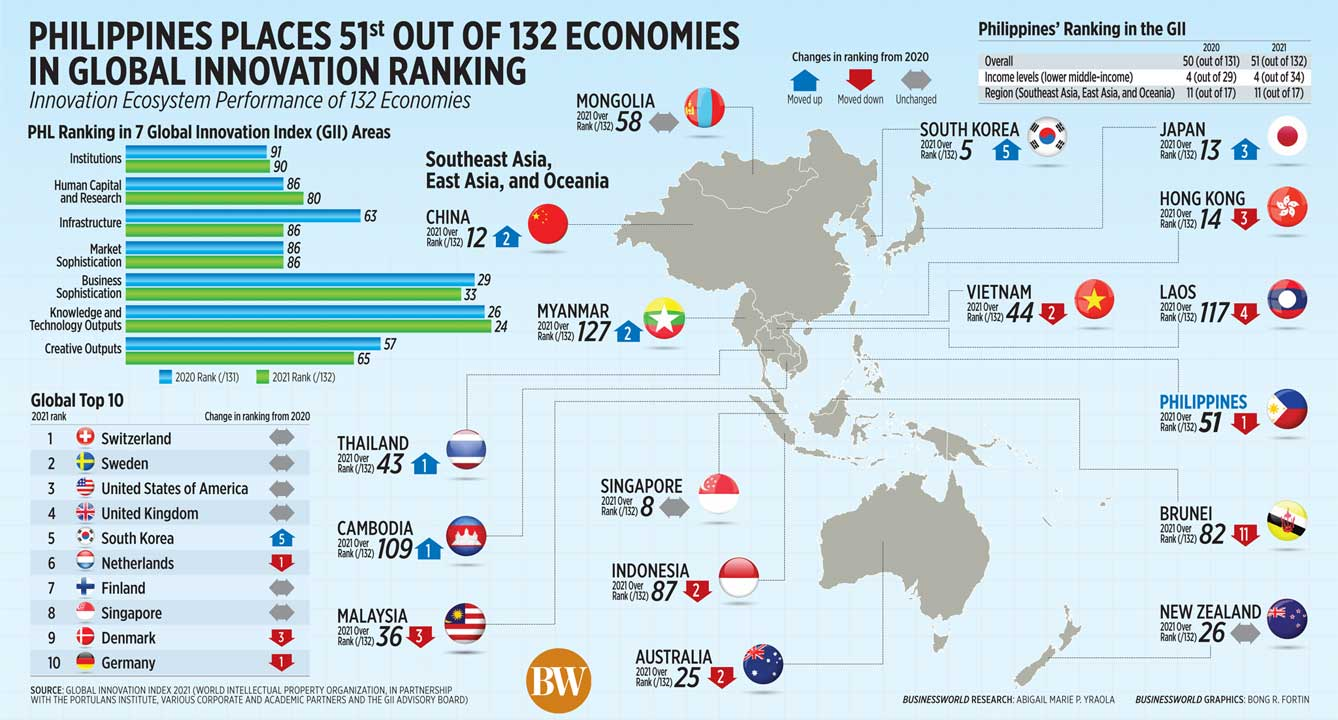
The Philippines has slipped two places in the 2026 Global Innovation Index, ranking 52nd out of 139 economies. But beyond the ranking itself is a more important question: can the country turn its growing pool of research, technology, and talent into innovations that actually reach the market?
The latest index shows a mixed picture. While the Philippines remains one of the stronger innovation performers among lower-middle-income economies, its innovation inputs weakened this year. The country ranked 69th in innovation inputs, while maintaining its 49th position in innovation outputs.
That gap points to a familiar challenge for the Philippine innovation ecosystem: the country can produce ideas, research, and technology, but scaling those innovations remains difficult.
From Research to Real-World Technology
The Department of Science and Technology (DOST) says the next step is strengthening the connection between research institutions, industry, investors, and entrepreneurs.
The agency is pushing for greater private-sector investment in research and development and stronger pathways for technologies developed in the Philippines to move from laboratories into actual businesses and industries.
This is particularly relevant as technologies such as artificial intelligence, biotechnology, semiconductors, advanced manufacturing, and climate technology become increasingly important to economic competitiveness.
For the Philippines, having capable researchers is only part of the equation. A promising technology also needs funding, market validation, industry partners, intellectual property support, and a path toward commercialization.
The Missing Link: Scaling
The country's innovation output ranking suggests that Filipinos are already capable of producing meaningful research and technological results.
The challenge is scale.
DOST has emphasized the need for an innovation ecosystem that can move an idea through several stages—from discovery and validation to trusted technology, industrial adoption, and eventually global markets.
That requires more than launching individual programs. It requires stronger connections between universities, government agencies, startups, corporations, investors, and researchers.
The recently held DOST–CHED Innovation Summit 2026 reflects this direction. The two agencies have been working on a portfolio of Philippine technologies that can be evaluated by industry and potentially commercialized, with the goal of bringing homegrown innovations closer to global markets.
A More Connected Philippine Innovation Ecosystem
The opportunity is significant.
The Philippines already has a growing startup community, a large pool of technology talent, expanding digital adoption, and research institutions producing solutions across different fields.
What remains critical is building the infrastructure that connects these pieces.
That could mean stronger technology-transfer offices, more accessible R&D funding, deeper industry-academe partnerships, better support for university spinouts, and more opportunities for Filipino startups to test and scale locally before entering international markets.
The country also cannot rely solely on government funding. Private-sector participation will be increasingly important if Philippine technologies are to move beyond prototypes and research papers.
Innovation Is More Than a Ranking
The Philippines' 52nd-place ranking should not be viewed simply as a setback.
The country remains within a relatively consistent range in the Global Innovation Index and continues to outperform the lower-middle-income group average across its innovation pillars. The 2026 results also show improvements in several areas, including R&D investment, scientific publications, technology adoption, electric vehicles, and labor productivity.
The bigger issue is whether those gains can be translated into sustainable businesses, stronger industries, better jobs, and technologies that solve problems at scale.
For a country with no shortage of ideas, the next phase of Philippine innovation may depend less on creating more ideas—and more on building the systems that allow the best ones to grow.
The Philippines already has the talent and the ideas. The challenge now is turning them into industries.