Manila — The Supreme Court of the Philippines officially launched its electronic notarization (eNotarization) service on Monday, allowing Filipinos to have electronic documents notarized online through accredited platforms. The service is meant to make notarization more convenient and accessible by letting the public process digital documents without relying solely on in-person visits to a notary's office.
The rollout implements the Rules on Electronic Notarization (A.M. No. 24-10-14-SC), which the Court En Banc approved on February 4, 2025. Reports on the launch say the first electronically notarized document was executed on the same day, with the UP College of Law and the Integrated Bar of the Philippines among the signing parties.
How it works
Under the rules, a commissioned Electronic Notary Public (ENP) can notarize eligible electronic documents in three ways:
- In-Person Electronic Notarization (IEN): the signatory appears physically before the notary.
- Remote Electronic Notarization (REN): the session is held by videoconference.
- A combination of both.
Documents must be in PDF or PDF/A format and processed through an Electronic Notarization Facility (ENF) accredited by the Supreme Court. The principal and any required witnesses create accounts on the platform, and the notary logs in to run the session. Users can then pick an ENP from the Court's published list of commissioned electronic notaries.
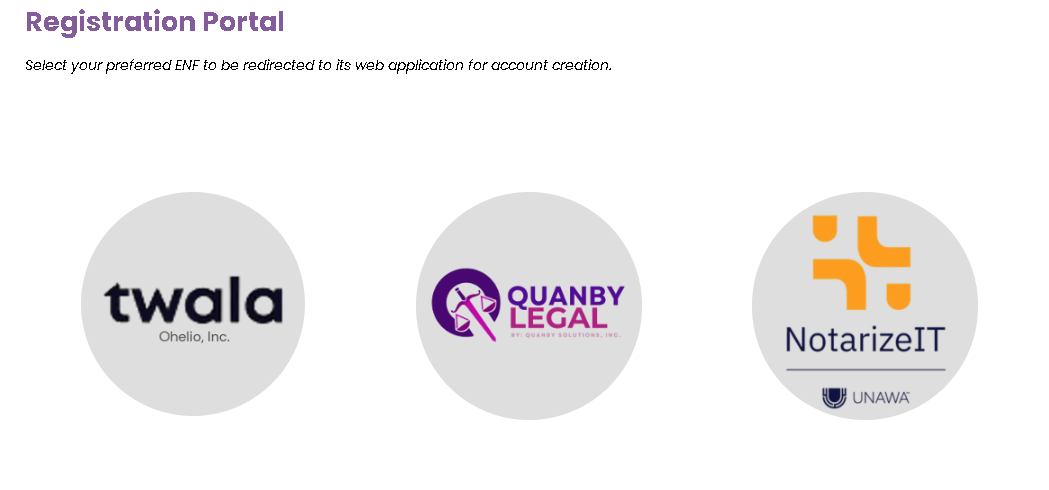
Three platforms are accredited in the first batch:
- NotarizeIT, operated by UNAWA Inc.
- Twala, operated by Ohelio Inc.
- QLegal, operated by Quanby Solutions Inc.
To guard against fraud and identity theft, the Court requires transactions to run only through accredited facilities that have identity verification and security safeguards. The Court has also posted instructional videos and a helpdesk form for questions.
Not limited by territory
Unlike traditional notaries, who are confined to the territorial jurisdiction of their commissioning court, commissioned ENPs may generally perform electronic notarial acts for principals located anywhere in the Philippines. In limited cases, the rules also allow notarization for principals outside the country.
Government agencies are on board
On October 13, the Court signed joint memorandum circulars with the Land Registration Authority (LRA) and the Securities and Exchange Commission (SEC) setting out how electronically notarized documents will be accepted, verified and processed. The agreements cover transactions handled by the two agencies, including property-related dealings and corporate filings.
What eNotarization does not do
The Court stressed that eNotarization supplements, and does not replace, traditional notarization; both options remain available. Paper documents with handwritten signatures or marks stay under the 2004 Rules on Notarial Practice. The electronic process also excludes notarial wills and depositions, and a notary commissioned under the 2004 rules is not automatically authorized to notarize electronically.
Why it matters beyond the courts
For founders, freelancers, small businesses and families, notarization is a routine bottleneck: lease contracts, affidavits, board resolutions, deeds and incorporation papers often wait on a trip to a notary. Moving eligible documents online, with LRA and SEC acceptance already worked out, could shorten those steps and open notarial services to people far from a notary's office. The change also fits a longer shift. The Court introduced temporary remote notarization of paper documents during the COVID-19 pandemic, and the 2025 rules turn that stopgap into a permanent framework.
The Court said the nationwide rollout forms part of its Strategic Plan for Judicial Innovations 2022–2027, which includes using technology to deliver judicial services. Information on the rules, accredited facilities, commissioned ENPs and application procedures is on the Court's eNotarization portal at sc.judiciary.gov.ph/enotarization.
Details such as notarial fees are prescribed by the Court and were not covered in launch reports reviewed for this article. Readers should check the portal before transacting.
Sources: Newsbytes.PH, Journal News Online, Gadget Pilipinas, Cruz Marcelo & Tenefrancia, ACCRALAW