
The 2026 South Luzon Innovation and Technology Transfer Summit brought together researchers, industries, and local governments to turn locally developed technologies into practical solutions for businesses and communities.
Scientific research can produce promising technologies, but bringing those innovations into the market requires more than a working prototype. Researchers need industry partners, businesses need solutions to real operational challenges, and institutions need mechanisms to support technology adoption and commercialization.
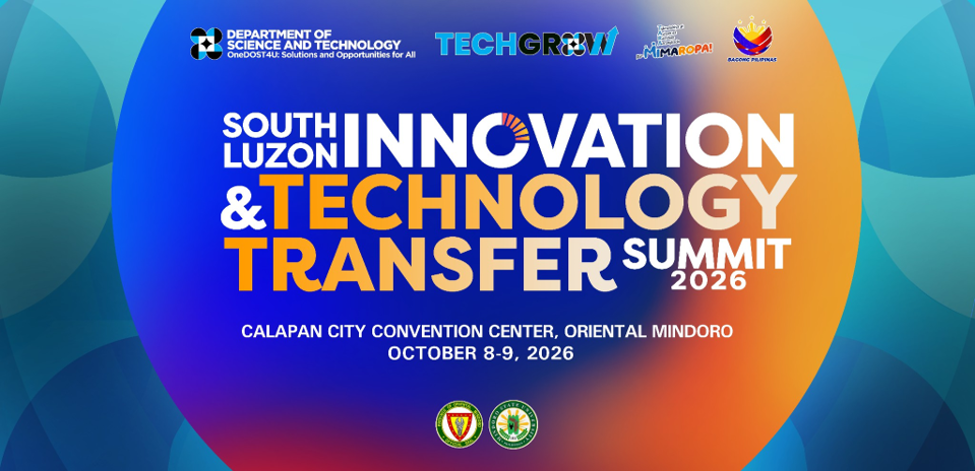
These connections took center stage at the 2026 South Luzon Innovation and Technology Transfer Summit (SLITTS), held on October 8–9 at the Calapan City Convention Center in Oriental Mindoro.
Organized by the Department of Science and Technology (DOST)-MIMAROPA in partnership with DOST-CALABARZON and DOST-Bicol, the two-day summit brought together researchers, technology developers, businesses, academic institutions, local government units, and other innovation stakeholders from MIMAROPA, CALABARZON, and the Bicol Region.
Under the theme “Where Problems Meet Solutions: Catalyzing Technology Transfer and Commercialization in South Luzon,” the summit focused on strengthening the connection between locally developed research and its practical applications.
Rather than concentrating solely on technology demonstrations, the event encouraged participants to identify real-world problems first and explore how research-based solutions could address them.
Putting Industry Challenges at the Center of Innovation
One of the summit's key activities was its reverse pitching sessions, where businesses and local government representatives presented their operational challenges, priority concerns, and technology needs.
Researchers and technology developers could then identify existing innovations that might address these challenges or determine where additional research and development would be necessary.
The process offers a different approach to innovation. Instead of developing technologies without a clear understanding of their eventual users, researchers can engage directly with potential adopters to explore practical applications.
The summit also featured technology pitching sessions, allowing developers to present research outputs and locally developed technologies with potential commercial or institutional uses.
Business matching activities provided opportunities for researchers and prospective adopters to discuss possible partnerships, technology licensing, collaborative research, and commercialization.
These discussions are important because developing an innovation and bringing it into use are separate stages. A technology may demonstrate technical potential but still require industry validation, funding, manufacturing support, or an appropriate partner before it can reach wider adoption.
Helping Local Innovations Move Beyond the Laboratory
Technology transfer was a central focus of the summit, particularly the challenge of helping research outputs progress from academic institutions and laboratories into actual products, services, and business applications.
The event formed part of the three-year TECHGROW Project, or Technology Transfer and Entrepreneurship Collaboration and Harmonization of Growing Regional Opportunities on Wealth Creation.
The initiative seeks to strengthen the capabilities of DOST regional offices, state universities and colleges, and local universities and colleges in developing, transferring, commercializing, and adopting market-driven technologies.
The summit also featured discussions on technology transfer negotiations and agreements, innovation management, productivity improvement, and research commercialization.
These areas are essential to building a stronger innovation ecosystem. Researchers need pathways to protect intellectual property and share their technologies, while businesses need clear arrangements for evaluating, licensing, and implementing solutions.
By bringing these groups together, the summit created a venue for exploring how regional research can contribute to enterprise development and community needs.
Project ISIP Brings Intellectual Property Assistance Online
Another initiative highlighted during the summit was Project ISIP, or the Integrated System for Intellectual Property Registration.
Developed by DOST-MIMAROPA through DOST Oriental Mindoro, the web-based platform is designed to connect innovators with intellectual property specialists and provide assistance throughout the registration process.
Protecting intellectual property is an important part of commercialization because it can help technology developers establish ownership of their work and explore opportunities to license or commercialize their innovations.
DOST is enhancing Project ISIP with planned artificial intelligence integration and mobile accessibility. The proposed improvements include guided drafting, intelligent intellectual property recommendations, and real-time application tracking.
The platform illustrates how digital tools can help make specialized support more accessible to innovators, particularly those who may need guidance navigating intellectual property procedures.
Connecting Regional Research With Real-World Applications
The summit also featured an exhibition of locally developed technologies, products, and programs from research institutions, universities, local governments, and DOST-assisted enterprises.
These demonstrations allowed participants to explore innovations with potential applications in business operations, public services, industry, and community development.
The gathering also highlighted experiences from technology adopters and university spin-offs, alongside discussions about innovation management and commercialization practices.
For regional innovation ecosystems, these connections can help identify opportunities that might otherwise remain within individual institutions. A technology developed by one research team, for example, may be relevant to a business or local government facing a similar challenge in another part of Southern Luzon.
However, establishing a connection is only the beginning. Successful commercialization still depends on technical readiness, financing, market demand, regulatory requirements, and the ability of prospective adopters to implement the technology.
The summit's value therefore lies not only in presenting available innovations but also in helping stakeholders explore the partnerships and processes needed to move them forward.
Building a Stronger Regional Innovation Ecosystem
The 2026 South Luzon Innovation and Technology Transfer Summit reflects a broader effort to make scientific research more responsive to the needs of businesses, industries, and communities.
By connecting technology developers with potential adopters across MIMAROPA, CALABARZON, and Bicol, the initiative aims to strengthen the pathways through which locally developed solutions can be transferred, adopted, and commercialized.
For Filipino startups and technology-based enterprises, stronger technology transfer networks can create opportunities to work with research institutions, access existing innovations, and develop solutions grounded in scientific research.
For universities and research organizations, closer engagement with industry can help identify relevant problems, potential users, and opportunities to bring their work beyond academic settings.
The long-term impact will depend on whether the discussions lead to sustained partnerships, actual technology adoption, and viable commercial applications.
The next stage of Philippine innovation will depend not only on what researchers can develop, but also on how effectively their discoveries reach the businesses and communities that can put them to use.