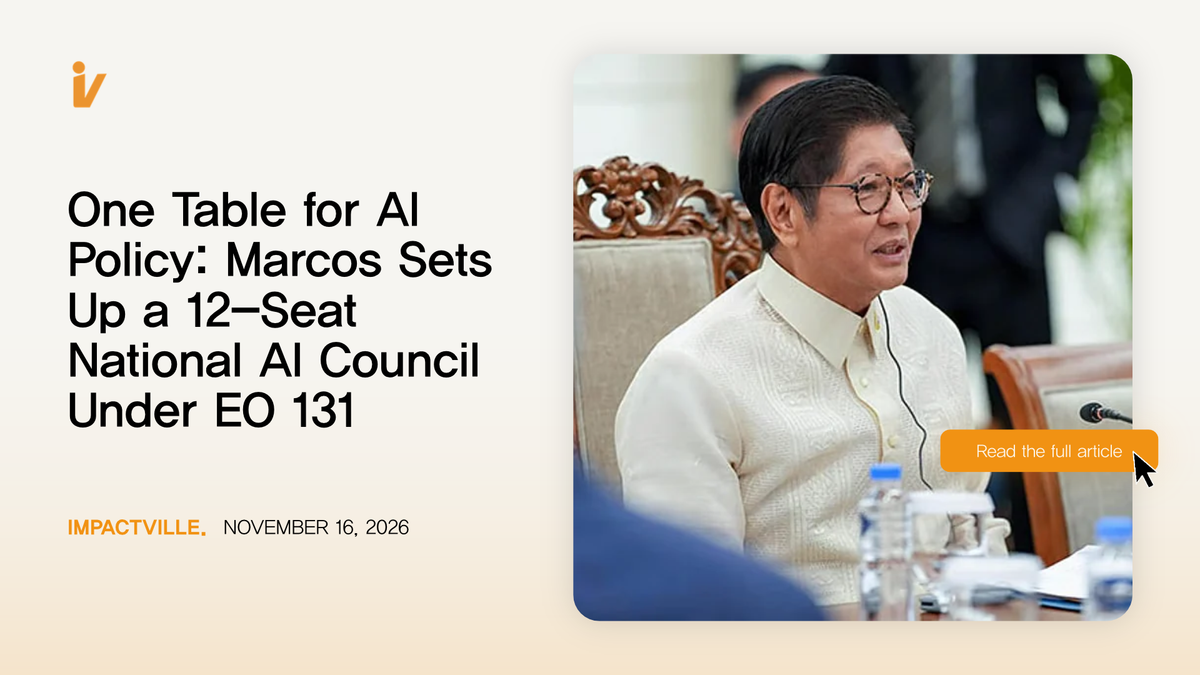
Manila — President Ferdinand Marcos Jr. has signed an executive order that puts the government's approach to artificial intelligence under a single coordinating body. Executive Order No. 131, signed on November 12 and announced by Palace Press Officer Claire Castro on November 14, adopts a national AI Governance Framework and creates the National Artificial Intelligence Council (NAIC) to oversee how it is carried out.
The order is not a new AI law and does not create a new regulator. It is a coordination layer: one council, one framework, and a quarterly reporting cycle that agencies will have to follow.
Who sits on the council
The NAIC is chaired by the Executive Secretary. The Secretary of the Department of Economy, Planning and Development (DEPDev) is vice chairperson, and DEPDev serves as the council's secretariat. Based on published summaries of the order, the other members are:
- The Secretaries of Information and Communications Technology (DICT), Science and Technology (DOST), Trade and Industry (DTI), Finance (DOF), Education (DepEd), Labor and Employment (DOLE), and Budget and Management (DBM)
- The Chairperson of the Commission on Higher Education (CHED)
- The Director General of TESDA
- One private-sector representative, appointed by the President from nominees put forward by business groups, for a renewable three-year term
That makes 12 seats, and only one of them is held by someone outside government.
What the framework says
According to summaries of the order, the framework rests on four elements: ethics and principles, standards and assurance, a risk-based policy toolkit, and enabling resources. It calls for AI to be developed and used with transparency, explainability, security, safety, accountability, fairness, equity and human-centricity, among other principles.
The approach is meant to scale with risk. Rules and checks should be heavier for higher-risk uses and lighter for low-risk ones. The toolkit is reported to include sector-specific guidelines, AI impact assessments, regulatory sandboxes and grievance mechanisms, backed by technical standards, testing and conformity assessments.
What the council will do
The NAIC is tasked with coordinating, facilitating and monitoring implementation of the framework and related government initiatives. Reported duties include:
- Harmonizing rules across agencies and reducing regulatory overlap.
- Recommending legislation for Congress to consider.
- Recommending safeguards for workers and learners affected by AI-driven changes in the labor market.
- Organizing technical working groups on institutions, data and R&D, capabilities, infrastructure, and demand generation. The last group covers public-private partnerships, financing, and AI adoption by startups and MSMEs.
Reporting and review
The DICT will build and maintain a digital monitoring platform. Agencies must log their deliverables and progress on it every quarter, and the council must report to the President within 30 days after each quarter ends. The framework itself is to be reviewed at least once every two years, or sooner if technology, regulation or markets shift.
What it does not do
As an executive order, EO 131 does not impose penalties, new business licenses or registration fees. Existing regulators keep their mandates. The National Privacy Commission, for example, continues to enforce the Data Privacy Act. Reports on the briefing also did not mention a budget for the council.
The order builds on the National AI Strategy for the Philippines, approved in May 2025, and follows months of calls for better coordination. In August, the Private Sector Advisory Council proposed a National AI Implementation Task Force, with business leaders saying the country already had a blueprint and that execution was the next challenge. A House think tank had earlier urged an executive order to regulate AI temporarily pending legislation, including a government-wide AI council.
Why it matters for the startup ecosystem
For Filipino AI startups, the order offers two things founders have asked for: a clearer picture of what rules may come, and a seat at the table through the demand-generation working group, which is meant to cover startup and MSME adoption. The risk-based, sandbox-friendly approach also suggests that small builders will not be treated like large deployers by default.
The open question is access. With a single private-sector seat on a 12-member council, startups will have to rely on business groups to carry their voice. Tech commentators have already flagged that limit. How the nominations work, and how the working groups engage founders, will decide whether the framework reflects how Philippine AI companies actually operate.
Sources
- Astig.ph: Marcos signs EO 131, creating a National AI Council and quarterly AI reports
- GizGuide: PBBM Signs Executive Order No. 131, Creates Philippine National AI Council and Framework
- SunStar: Marcos signs EO for AI Governance Framework (Nov. 15, 2026)
- DZRH: Marcos signs order creating national AI council, adopting governance framework (Nov. 14, 2026)