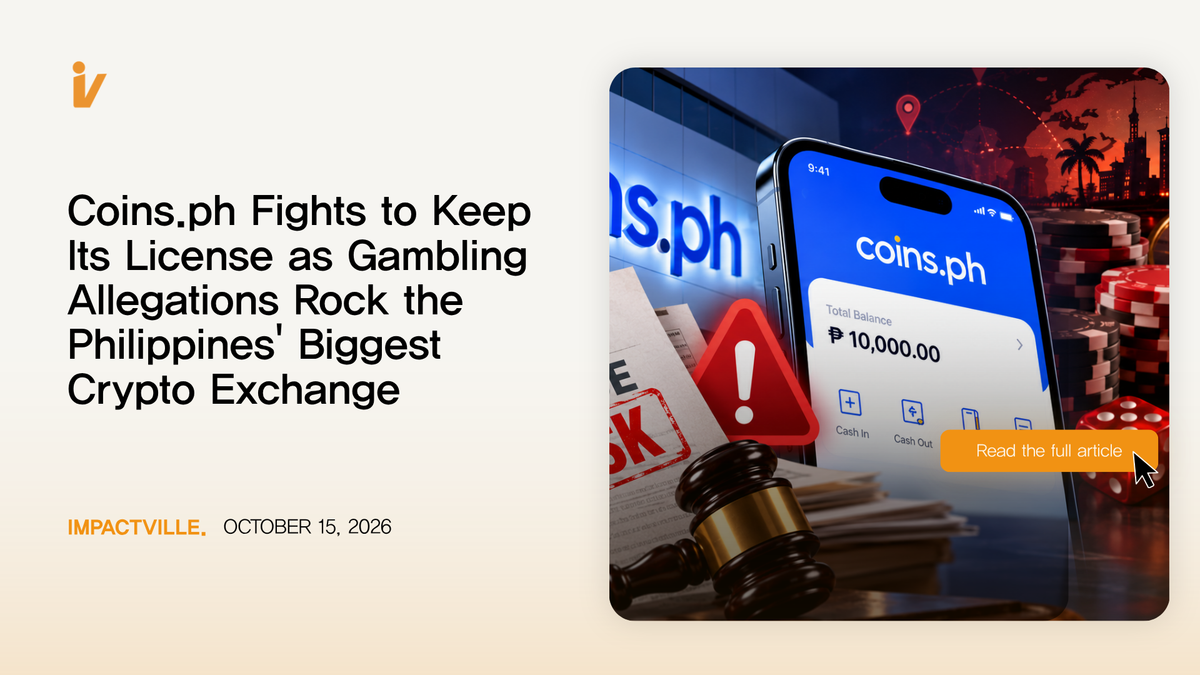
Manila — October 14, 2026. The platform that millions of Filipinos use to send, spend and trade money is now in a standoff with the country's central bank. Coins.ph, the Philippines' largest crypto exchange with more than 18 million customers, reportedly faces punitive action from the Bangko Sentral ng Pilipinas (BSP) over alleged links to offshore gambling operators. The company says it "firmly denies any claim that it knowingly serves offshore gaming or gambling operators," insists its customers' funds are safe, and says it remains BSP-licensed.
No license has been revoked. The BSP has not publicly commented. But the picture that is emerging, from a regulator's restriction, a wave of compliance exits and an exclusive report, is hard for the industry to ignore.
What was reported
CoinDesk reported on October 13, citing two people with knowledge of the situation, that Coins.ph faces regulatory action over business involving restricted offshore gaming and gambling companies. One source said the alleged infractions are serious enough that the 12-year-old company could be stripped of its license, an outcome that person said would cause "an earthquake" in the Philippine crypto ecosystem.
The allegations are unproven. Coins.ph has not been publicly charged with anything, and the BSP has not confirmed the reported grounds for any action.
The restriction customers already feel
The one step that is publicly documented happened on September 29. The BSP partially suspended DCPay Philippines, the e-money issuer behind Coins.ph's peso wallet, under Monetary Board Resolution No. 839, according to advisories and reports on the order. DCPay can no longer receive incoming InstaPay and PESONet transfers, so users cannot top up their peso wallets from banks and other e-wallets.
Outbound transfers to Philippine bank accounts and e-wallets, and QRPh merchant payments, continue to work. Coins.ph's separately licensed crypto trading company, Betur Inc., is not directly covered by the order. No public date has been given for restoring inbound access.
CoinDesk's sources said the restriction is not time-bound, unlike the temporary suspensions usually imposed for technical failures, and that no reason was given. The BSP has not publicly explained it. Coins.ph earlier said the BSP had instructed it to strengthen internal controls, though the BSP has not publicly linked that instruction to the restriction.
How gambling money may have moved, according to sources
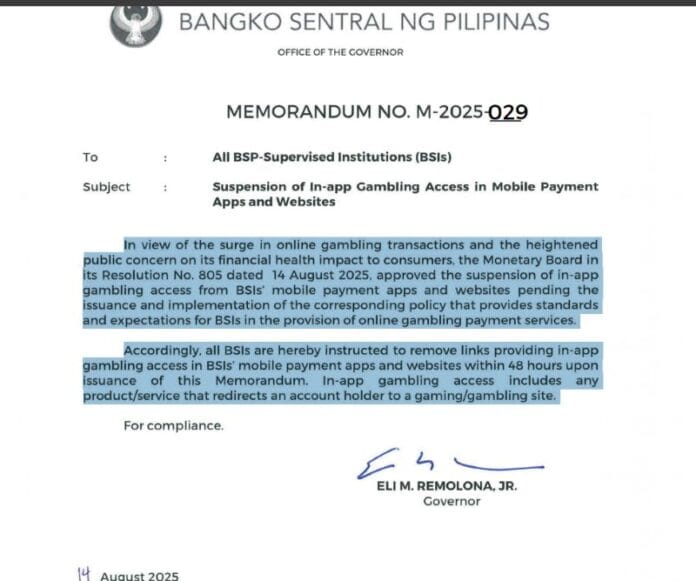
The story reaches back to August 2025, when the BSP ordered e-wallets and other supervised institutions to remove in-app links to online gambling sites within 48 hours (Memorandum M-2025-029). The directive came during a Senate hearing at which lawmakers cited nearly 12,000 illegal gambling sites operating in the country.
According to CoinDesk's sources, several gambling entities then migrated to Coins.ph. A third person familiar with central bank regulatory processes said the move also gave those firms access to crypto and stablecoins to pay offshore partners. That account comes from anonymous sources, and Coins.ph rejects the suggestion that it knowingly served such operators.
Compliance exits raise questions
CoinDesk also reported that several high-profile compliance staffers left the exchange this year: chief compliance officer Lexi Herrera, head of AML transaction monitoring Chris Beaño, and money laundering reporting officer Irish Calagui. No reason for the departures has been reported, and no source links them to the BSP action. They are, however, the kind of roles regulators examine closely when anti-money-laundering controls are in question.
Coins.ph's response
The company's statement says it holds itself to the standards of the BSP, the Anti-Money Laundering Council (AMLC) and other regulators, and that "full compliance sits at the core of how we operate." It told CoinDesk it expects to fully restore affected services soon. A spokesperson told Cointelegraph that the exchange does not accept or permit offshore gambling operators and continuously screens customers and transactions in line with BSP requirements.
Why this matters beyond one company
- Scale. CoinDesk reports that Coins.ph handles about $50 million in 24-hour spot volume and controls roughly 75% to 80% of peso-to-stablecoin liquidity in the country.
- Remittances. More than 10.8 million Filipinos live abroad and send home about $43 billion a year, mostly through banks and money transfer services. Any disruption to a major peso-stablecoin route raises questions for users who depend on crypto rails.
- Regulatory signal. The BSP has spent more than a year tightening the link between payment apps and gambling. How it treats a market leader will tell every licensed platform where the line is.
- Trust. Coins.ph began as one of the Philippines' earliest crypto wallets, was acquired by Gojek for $95 million in 2019, and was later sold to former Binance CFO Wei Zhou. A license dispute would test the trust of a user base larger than many banks'.
What to watch next
- Whether the BSP issues a public statement or a formal order, and on what grounds.
- Whether DCPay's inbound InstaPay and PESONet access is restored, and when.
- Whether Coins.ph explains the compliance departures and how it has strengthened its controls.
- Whether the BSP's policy on online gambling payment services, still being finalized, adds new obligations for crypto platforms.
Sources: CoinDesk, BitPinas, Cointelegraph, Fintech News Philippines, crypto.news, Coinpedia, Blockonomi, Inquirer (BSP e-wallet gambling order), GGRAsia