A familiar Filipino dessert ingredient is being explored as a potential material for a very different purpose: helping separate salt from water.
Nata de coco may be best known for its chewy texture in desserts and drinks, but its underlying material—bacterial cellulose—is attracting attention from Filipino researchers working on water-treatment technology.
A team from Malayan Colleges Laguna, the University of the Philippines Los Baños, and De La Salle University developed a forward-osmosis membrane using bacterial cellulose derived from nata de coco as its base material.
From Coconut Water to Water Filtration
The research builds on the unique structure of bacterial cellulose. Its network of extremely fine fibers gives it properties such as strength, flexibility, moldability, and the ability to function as a separation material.
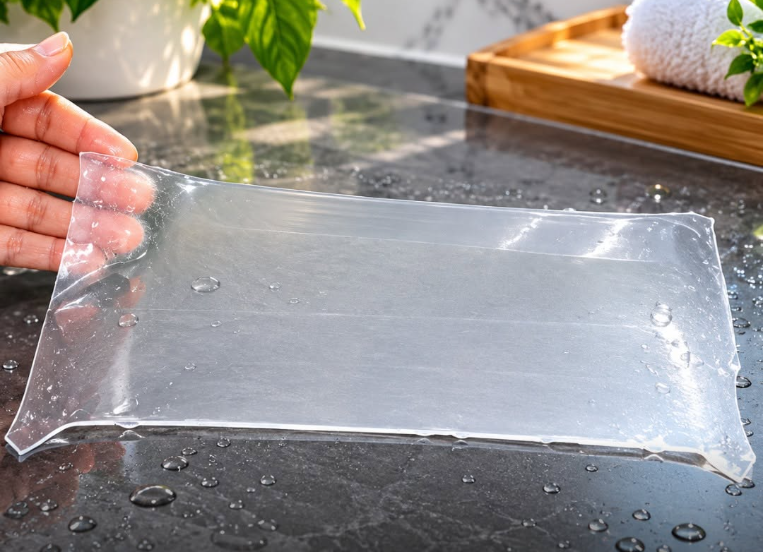
Instead of using commercially produced membrane materials from the start, the researchers produced bacterial-cellulose films using a nata starter and coconut water. The films were then modified using sodium alginate and calcium chloride to create a denser membrane suitable for forward osmosis.
The resulting material was tested in a laboratory-scale system using a sodium chloride solution designed to simulate seawater.
Promising Results, But Not Yet a Replacement
The best-performing nata de coco-based membrane achieved 88.39% salt rejection and a water flux of 4.01 liters per square meter per hour (LMH).
For comparison, the commercial cellulose tri-acetate membrane used as the benchmark achieved 100% salt rejection and a water flux of 7.87 LMH.
The results show that the locally developed material has potential, but the researchers did not present it as a replacement for existing commercial membranes. Its salt rejection and water flux would still need to be improved before it could compete with established materials.
A Local Material With Bigger Possibilities
What makes the research notable is not simply the use of nata de coco, but the possibility of turning a familiar, locally available material into a functional component for emerging technologies.
The researchers described the work as the first attempt in the Philippines to fabricate a low-cost forward-osmosis membrane from locally available nata de coco.
The project was supported by a DOST-PCIEERD grant and conducted at the Environmental Research Laboratory of Malayan Colleges Laguna.
For a country with abundant coconut resources, the research points toward a broader question: what other everyday agricultural materials could be engineered into technologies with applications far beyond their traditional uses?
Nata de coco may have started as a dessert ingredient. With further research, its bacterial cellulose could become part of the next generation of locally developed materials for water treatment and other environmental technologies.
From something we eat to something that could help clean water, nata de coco is showing that Filipino innovation can sometimes begin with materials hiding in plain sight.