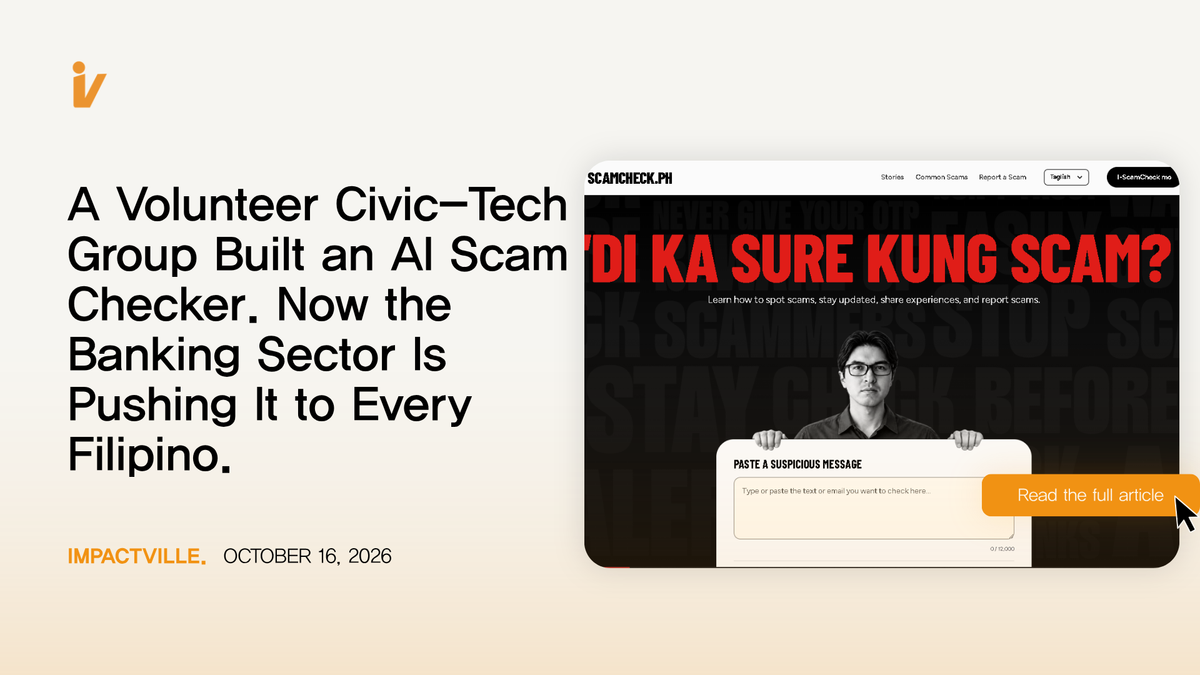
Manila, Philippines — October 16, 2026. Before you tap that link, reply to that "urgent" text, or send money to a stranger, Filipinos now have a free place to get a second opinion. ScamCheck.ph, an AI-assisted tool developed by the volunteer-led civic technology group BetterGov.ph, lets users paste a suspicious message or upload a screenshot and get a read on whether it looks fraudulent.
BetterGov.ph founder Jason Torres welcomed the nationwide rollout, saying a simple idea he had a year ago has become a national initiative.
What ScamCheck.ph does
The site is built around four services:
- An AI-assisted scam checker for pasted texts and emails, plus uploaded screenshots of suspicious conversations.
- Scam Stories, illustrative scenarios that show how common schemes unfold and what warning signs to watch for.
- A reporting guide on what to do after encountering a scam or becoming a victim.
- An educational library on different types of online fraud.
The platform also tells users to hide names, account numbers, passwords and one-time passwords before submitting anything. The site is available in Taglish, Tagalog and Bisaya, and reminds users that banks never ask for an OTP, password, full card number, CVV or PIN by text, call or email.
From a bank-and-volunteer project to a national campaign
ScamCheck.ph did not start this week. According to Rappler, it was first developed in late 2025 by Metrobank and BetterGov.ph. It is now being promoted widely by the Bank Marketing Association of the Philippines (BMAP) under the campaign "Ang Mahal ma-Scam, i-scamcheck.ph Mo Muna."
The push got a bigger stage on October 12, when the Bangko Sentral ng Pilipinas (BSP), BMAP, Google.org and the ASEAN Foundation kicked off the Philippine leg of the Scam Ready ASEAN Program at the BSP head office. The regional program aims to reach three million people and train 2,000 "master trainers," with around 100 to be deployed in the Philippines. It also includes Scam Ready, a Google-backed game that teaches players to spot phishing, fake investments and social-engineering tricks.
Why it matters: the numbers
The 2026 State of Scams Philippines Report, from the Global Anti-Scam Alliance (GASA) with Mastercard and Gogolook, surveyed 1,160 adults between March and April 2026. Its findings:
- 84% of Filipino adults encountered a scam attempt in the past year, up from 77% in 2025.
- Estimated annual losses reach ₱121.8 billion, with an average of ₱10,427 per victim. This is a survey-based extrapolation, not an official tally.
- 73% of victims said scammers received payment through e-wallets, up from 34% in 2025.
- 39% of scam encounters happened on instant messaging apps and 36% on social media.
- Although 58% of respondents felt confident they could spot a scam, 60% of those who encountered one still engaged with it.
- 82% of victims said the experience hurt their mental well-being, and only 4% of respondents reported scams to authorities.
A separate TransUnion report found that 72% of surveyed Filipinos were targeted by digital fraud between August and December 2025, with a median loss of about $850. TransUnion's read is that fraud here is driven more by scale than severity: many smaller scams rather than a few huge ones.
GASA's Asia-Pacific director said the burden of stopping scams should not fall on consumers alone. A tool that works at the moment of doubt, before money moves, is one way to share that burden.
A one-year-old movement
BetterGov.ph launched on September 19, 2025, as a volunteer effort to build a better national government website, reportedly for about ₱3,000. Its own retrospective counts 28 projects in its first hundred days and more than 3,600 Discord members. In July, it was selected for the Mozilla Foundation's Democracy x AI Incubator, one of ten projects worldwide.
The group holds its first summit tomorrow, Saturday, October 17, in Quezon City, where Torres has said a BetterGov Fellowship for civic-tech projects will launch.
The takeaway for ImpactVille readers
ScamCheck.ph is a useful example of civic tech scaling: volunteers build, a bank co-develops, an industry body and the central bank amplify it. It is a checker, not a guarantee. Treat its result as a second opinion, never click first, and report scams through official channels.
Sources: TechWatch PH, Rappler, BitPinas, Astig.ph, ScamCheck.ph, Rolling Stone Philippines, OneNews.ph, Newsbytes.PH, Visayan Daily Star (TransUnion), Gadget Pilipinas, OSSPH